When domestic violence affects a foreign spouse and children in China, safety and family-court issues can arise at the same time. A personal safety protection order may address immediate contact or residence risks, while custody and visitation require separate decisions based on the child’s interests. Keeping a clear record helps a court assess each issue without confusing an urgent safety request with a final custody result.
Mainland law allows a person facing domestic violence or a real risk of it to seek a protection order without first filing for divorce. Recent Supreme People’s Court rules also address evidence involving children and disputes where a parent takes or hides a child. This guide explains the available court routes and the evidence to preserve; it does not replace an urgent safety plan or case-specific advice.
Start with immediate safety and a factual record
If you or a child faces immediate danger, move to a safer place if possible and contact local emergency services. Preserve records only when doing so does not increase risk. Keep a dated log of incidents, threats, injuries, witnesses, and any attempts to contact or follow you. Save original messages, photographs, audio or video, medical records, police records, and requests for help to community or support organizations. Make secure copies that the other person cannot access.
For incidents involving a child, record what the child experienced or witnessed in a factual, age-appropriate way. Do not coach the child or ask them to repeatedly recount events. The 2022 SPC rules list testimony from a minor child where appropriate to the child’s age and intelligence, along with other witness statements and records of complaints or requests for help, as possible evidence in a protection-order case.
Protection orders are a separate safety route
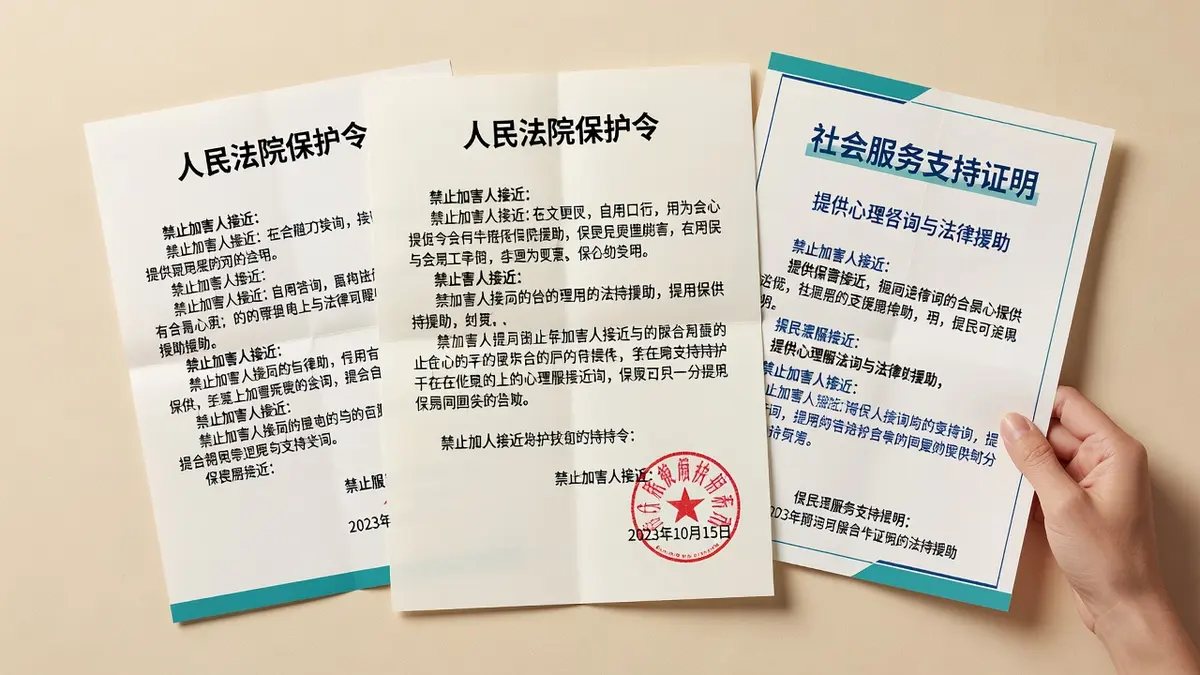
A person who has suffered domestic violence or faces a real risk of it may apply to a people’s court for a personal safety protection order. A divorce or custody lawsuit does not have to be filed first. Depending on the facts and requested relief, an order may prohibit violence, harassment, stalking, or contact; require the respondent to leave the applicant’s residence; or include other protective measures authorized by law. The court decides whether the evidence and requested terms meet the legal requirements.
Applications are handled by a basic people’s court connected to the applicant’s or respondent’s residence or the place where the violence occurred. The Anti-Domestic Violence Law sets a decision period of 72 hours after the court accepts the application, or 24 hours in urgent circumstances. These are decision deadlines under the statute, not a promise that every request will be granted or filed the same day. A protection order generally lasts no more than six months and can be revoked, varied, or extended on application before it expires.
A protection order does not decide custody by itself
Parents remain responsible for their children after separation. Under Civil Code Article 1084, decisions about a child living with one parent after divorce must follow the principle most beneficial to the minor child. Safety concerns and reliable evidence may be relevant, but an order’s existence alone does not automatically determine custody. The SPC’s 2022 rules state that in a divorce case the court should assess whether domestic violence occurred based on the evidence as a whole, even if a protection order was previously issued.
Use separate, clear requests for different outcomes: immediate safety restrictions in a protection-order application; temporary or final arrangements for the child in the appropriate family proceeding. Include practical details about residence, school pickup, exchanges, communications, travel, and who may collect the child, while avoiding arrangements that expose the child or applicant to further risk. A court can assess the evidence and the child’s needs under the relevant procedure.
If a parent takes or hides a child
Do not respond by secretly relocating or concealing the child. The Supreme People’s Court’s 2025 Interpretation II on Marriage and Family addresses applications for a protection order or personality-rights injunction where one parent or relatives take or hide a minor child. It also explains that a parent who claims the other parent’s gambling, drug use, or domestic violence justifies taking or hiding the child should use legal procedures such as seeking a change in custody, suspension of visitation, or revocation of guardianship where the legal conditions are met.
Preserve messages about the child’s location, school attendance, handovers, and contact, and promptly obtain legal advice about the appropriate court application. The court may make temporary arrangements during separation in circumstances described by the 2025 interpretation. The specific remedy depends on the child’s situation and evidence; self-help can create additional legal and safety problems.
Foreign spouse and document planning
Keep passports, visas, residence permits, marriage and birth records, and translations accessible, but do not assume that family violence or a divorce automatically changes immigration status in a specific way. Immigration permission is a separate question for the local exit-entry administration. Ask about your individual status and any filing deadlines while addressing immediate safety through the police, court, or support services.
For court use, organize a short chronology, identify what each piece of evidence proves, and keep original electronic files where possible. Ask the relevant court or counsel about identity-document, translation, and filing requirements. If an order is issued, keep a copy and record any suspected violation for the court and police. Genyu Wang assists foreign spouses with Mainland family-law procedures and evidence preparation.