
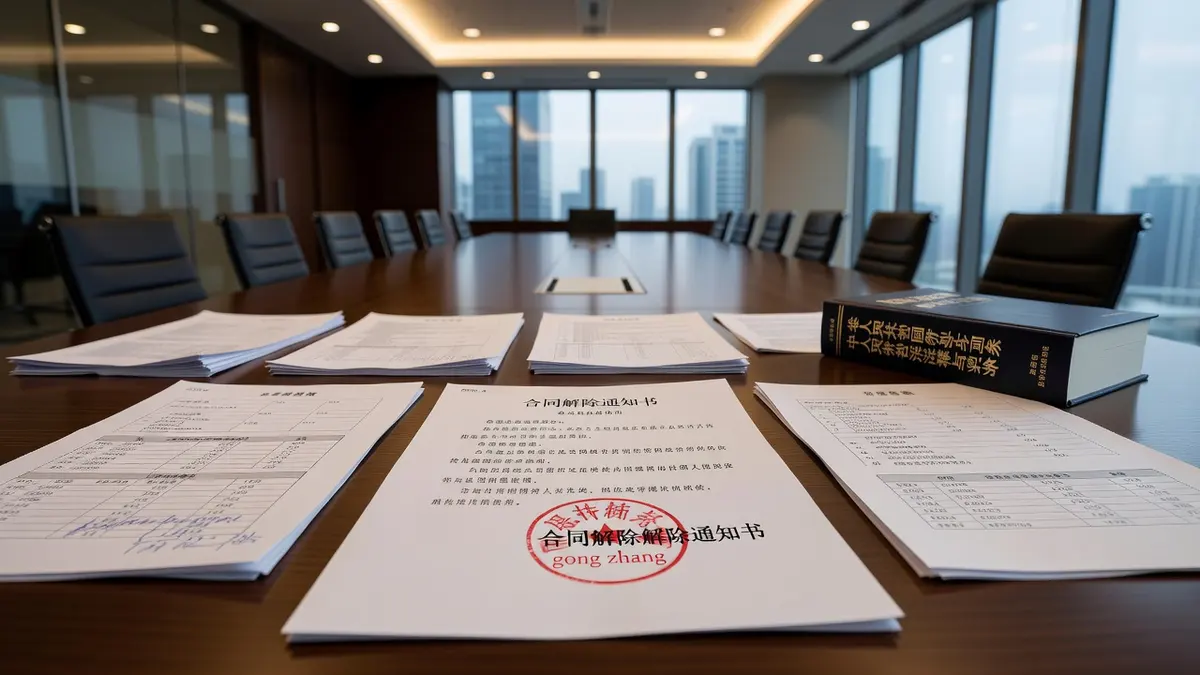
A low performance rating can affect a job, but a last-place ranking does not by itself prove that an employee is legally incompetent for the position under Chinese labor law. The Supreme People’s Court’s Guiding Case No. 18 rejected a dismissal that relied on a relative ranking without proving the statutory ground for termination.
If an employer says a poor review justifies dismissal, check the reason stated in writing, the standard used to assess your work, and what training or job adjustment occurred. The legal test depends on the evidence and the employer’s process; an employee’s rating alone does not resolve the dispute.
What the Supreme People’s Court decided
In Guiding Case No. 18, ZTE Corporation (Hangzhou) used a performance system that placed a fixed proportion of employees in a low category. Wang Peng received a C2 rating, and the employer argued that he was unable to perform his job even after a transfer. The Supreme People’s Court explained that the C2 category did not necessarily mean the employee was unable to do the work. The employer also failed to show that the transfer was made because of inability: the move followed the dissolution of a department, and the employee continued doing sales work.
The court concluded that the ranking alone did not establish the legal ground for unilateral termination. This case does not make performance ratings irrelevant. It shows that an employer must connect the evidence to the statutory ground it invokes, and that a reassignment made for another reason does not automatically satisfy the legal requirement.
How the statutory rule works
Article 40(2) of the Labor Contract Law allows an employer to terminate for inability to perform the job only where the employee remains unable to do so after training or adjustment to another position. Article 40 also requires written notice 30 days in advance or an additional month’s salary for the employer-initiated termination covered by that article. Whether those steps and the underlying reason are established depends on the record and the circumstances.
A company policy that automatically dismisses the lowest-ranked employee may raise a different question from a documented finding that a particular employee cannot perform defined job duties. Ask what job-related standard was applied, whether it was communicated, how your actual work was assessed, and whether the employer offered training or a genuine position adjustment before relying on Article 40(2).
Records to keep after a poor review
- Your labor contract, job description, amendments, and performance criteria that applied during the review period.
- Performance-review results, scoring rules, ranking communications, targets, and any written explanation for the rating.
- Training plans, attendance or completion records, feedback, support offered, and later assessments.
- Documents about a transfer or changed duties, including when it happened and the reason the employer gave.
- Dismissal notice, effective date, settlement draft, pay records, and communications about compensation.
Keep only records you are permitted to retain. Do not remove trade secrets, customer information, or other confidential material. If you cannot lawfully keep a document, record its title, date, sender, and location and ask counsel how to request it.
Questions to ask before signing a termination document
- Does the document state that you agree to terminate, or only confirm that you received notice?
- Does it waive claims, confirm final payment, or settle every dispute?
- What legal ground and evidence does the employer identify?
- Was training or a real adjustment to another position offered, and did the employer assess your work afterward?
- How is any economic compensation calculated, and is the proposed amount consistent with your service and wage records?
Ask for time to review any waiver or settlement you do not understand and keep a copy of documents you sign. A signature’s effect depends on the wording and circumstances, so have the document reviewed where the amount or employment consequences are significant.
Possible remedies and dispute timing
If a termination is found unlawful, Article 48 provides for continued performance when the employee requests it and continuation remains possible. If the employee does not request continuation or the contract cannot continue, Article 87 provides compensation at twice the economic-compensation standard in Article 47. These remedies are not automatic: the claim, evidence, and legal requirements must be assessed in the particular case.
Labor disputes generally have an arbitration filing limitation period of one year from when the party knew or should have known of the rights infringement, subject to statutory rules on interruption, suspension, and certain wage claims during an ongoing labor relationship. Because calculating a deadline can depend on the claim and events after dismissal, seek advice promptly and confirm the filing requirements with the competent local labor-dispute arbitration commission.
Practical first steps
- Save the written review and termination notice, and note the date you received each.
- Write a timeline of reviews, coaching, training, changed duties, and conversations with management.
- Compare the employer’s explanation with your job description and the actual evidence of your work.
- Request a clear calculation of any proposed compensation and do not sign a broad release before understanding it.
- Consult an employment lawyer promptly if dismissal is imminent, a deadline may be running, or the employer asks you to sign a settlement.
Official references: Supreme People’s Court Guiding Case No. 18; Labor Contract Law, Articles 39–43; Articles 42–48; Article 87; and Labor-dispute Mediation and Arbitration Law, Article 27.
This article is general information, not legal advice. A performance dismissal must be assessed against the actual contract, evidence, procedure, and local practice.