
If you are hurt while working in China and your employer has not filed a work-injury recognition application, you may have a direct filing route. The employer’s general deadline is 30 days, while an injured employee, a close relative, or a trade union may apply directly within one year. Those periods run from different triggering events and should be tracked carefully.
This guide focuses on the steps when the employer does not act: confirm the deadline and competent local authority, assemble proof of the work relationship and injury, submit the application, and respond to any written request for missing materials. It explains the national procedure without assuming that every foreign employee or injury automatically qualifies.
Separate injury recognition from benefit payment
A work injury recognition application asks the social insurance administrative department to decide whether the injury qualifies under the work-injury rules. It is a threshold procedure; it does not by itself decide every benefit amount or resolve every dispute with the employer. If the employer has not filed, focus first on making a timely application with a usable record.
Track both filing periods
Under Article 17 of the State Council’s Work-Related Injury Insurance Regulations, an employer generally must apply to the social insurance administrative department for the coordinating area within 30 days after the accident injury, or within 30 days after the employee is diagnosed or identified as having an occupational disease. In special circumstances, the period can be extended with the department’s approval. Do not assume an extension exists unless it was approved.
If the employer does not apply within its time limit, the injured employee, a close relative, or a trade union may apply directly within one year from the date of the accident injury or the date the occupational disease was diagnosed or identified. This is the deadline for the work-injury recognition application. It is not a general deadline for every wage, benefit, or employment claim. Record the relevant start date, preserve evidence of any employer filing or extension, and seek local advice early if the date or status of an earlier application is unclear.
The Regulations also place qualifying work-injury benefit expenses arising during the period after the employer’s 30-day filing period and before its application on the employer. The exact benefit and expense categories depend on the applicable rules and facts; keep receipts and payment records rather than assuming that a later filing resolves the gap.
Identify who may apply and where
The national rule allows the injured employee, a close relative, or a trade union to make the direct application if the employer did not file on time. The application is made to the social insurance administrative department for the relevant coordinating area, generally connected to the employer’s location. If the employer is unregistered, coverage was arranged elsewhere, or the employing entity is disputed, ask the local human resources and social security authority which office has jurisdiction before filing. Local service channels and intake requirements can differ.
An employer’s refusal to cooperate is not, by itself, a reason to wait past the filing period. The national rules provide a direct application path. Keep a dated record of requests to the employer and its responses, but do not let those discussions replace filing with the competent authority.
Build the core application file
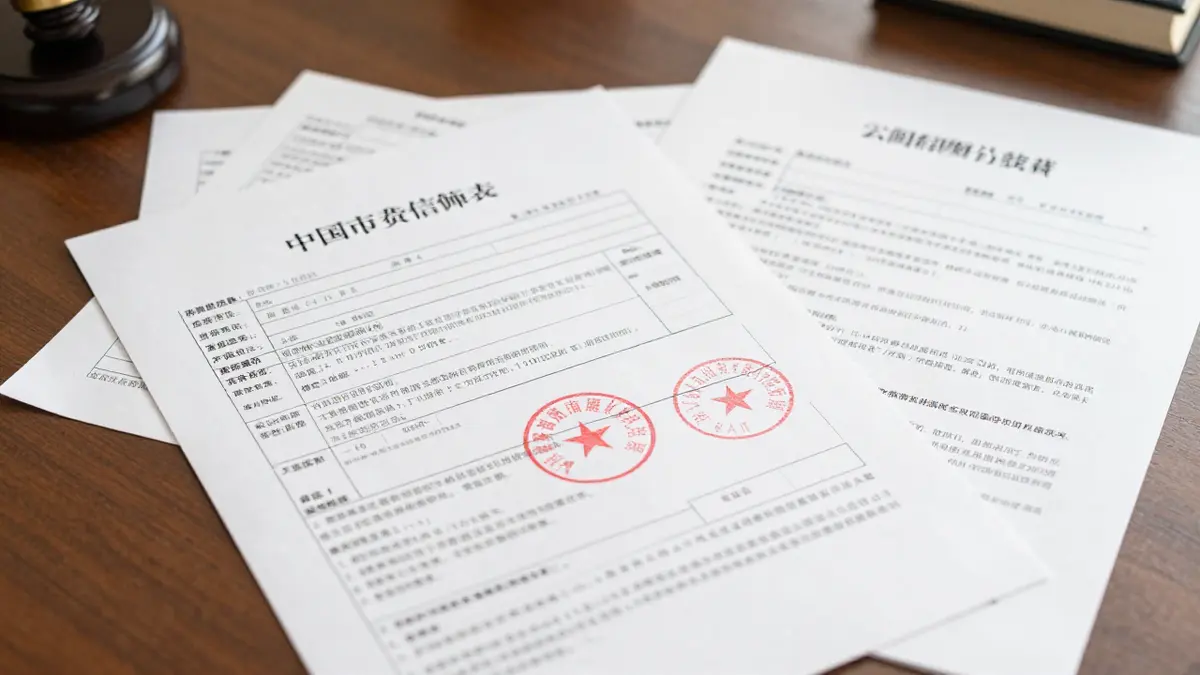
Article 18 of the Work-Related Injury Insurance Regulations and Article 6 of the Ministry of Human Resources and Social Security’s Work Injury Determination Measures identify the core application materials:
- The work-injury recognition application form, with the accident date, place, cause, and injury information.
- A copy of the labor or employment contract, or other evidence of the employment relationship, including a factual labor relationship where there is no written contract.
- A medical diagnosis certificate for the injury, or the required occupational-disease diagnosis or identification document.
For the factual account, add the evidence that helps explain why and how the injury occurred during work: a job assignment, shift roster, work order, employer message, entry record, incident report, witness details, or available video. Keep original files and note their source and date. If you are a foreign employee, keep your passport and relevant work-permit, employment, assignment, and payroll records available as supporting identity and employment evidence. The authority may specify local forms or request additional material; these examples do not replace its checklist.
Describe the event in a short chronology. Match each key statement to a document, witness, or medical record. If the employer says the incident was not work-related, include the facts that support your account; the measures also place the burden of proof on the employer when the employee or close relative says the injury is work-related and the employer denies it. That rule does not make an unsupported application automatic, so submit the evidence you can obtain.
File, keep proof, and answer completeness notices
Submit the application to the competent social insurance administrative department and keep a full copy of everything submitted. Ask for a dated receipt, acceptance notice, or other proof of delivery. If the materials are incomplete, the department must give written notice of the full set of items it needs to supplement. The Work Injury Determination Measures generally give the department 15 days to review the materials and decide whether to accept; after it receives all supplements, it has another 15 days to decide. Respond to a written supplement request promptly and keep proof of that response.
After acceptance, the general period for a decision is 60 days. The Measures provide a 15-day decision period for applications where the facts are clear and the rights and obligations are clear. A decision may take longer where it must wait for a conclusion from a court or another authority; the department should notify the applicant in writing when the statutory clock is suspended for that reason. Keep the acceptance and all later notices together so you can track the case status.
If the employer did not enroll you in work-injury insurance
Work-injury recognition and insurance enrollment are related but separate questions. Article 41 of the Social Insurance Law says that where an employer failed to pay work-injury insurance contributions, the employer must pay work-injury benefits; if it does not pay, the work-injury insurance fund may make an advance payment and recover the amount from the employer under the statutory procedure.
The Ministry’s Interim Measures on Advance Payment of Social Insurance Funds set conditions for requesting advance payment. For work-injury benefits, the employee must first have a work-injury recognition decision, and the request is made to the social insurance agency with supporting material. This route is not an automatic immediate payment or a substitute for the recognition application. Keep the written decision, medical records, original receipts, employer payment requests, and any response or refusal.
After the recognition decision
Read the decision and its stated legal basis. If the decision refuses recognition or the authority declines to accept the application, the Work Injury Determination Measures state that the employee or close relative may seek administrative review or bring an administrative lawsuit; the decision should identify the available route and time limit. Get advice promptly rather than relying on a remembered deadline.
If the injury is recognized and treatment later stabilizes but a disability affects work capacity, a separate labor-capacity assessment may be needed before certain disability benefits can be determined. Keep the diagnosis, treatment, rehabilitation, work-absence, and wage records from the start. For a foreign employee, use a qualified translator for important notices and confirm the local office’s filing and translation requirements.
Primary legal sources
- State Council, Work-Related Injury Insurance Regulations, especially Articles 17–20 and 21–23.
- Ministry of Human Resources and Social Security, Work Injury Determination Measures, especially Articles 4–8, 17–23.
- Social Insurance Law of the People’s Republic of China, especially Articles 33, 36, and 41.
- Ministry of Human Resources and Social Security, Interim Measures on Advance Payment of Social Insurance Funds, especially Articles 6–10.
This article concerns the national application framework. The responsible office, local forms, evidence requests, and benefit process can depend on the employing entity and place of participation. Prompt local advice is especially important where the one-year period is approaching, the employer relationship is disputed, or serious injury or occupational disease is involved.