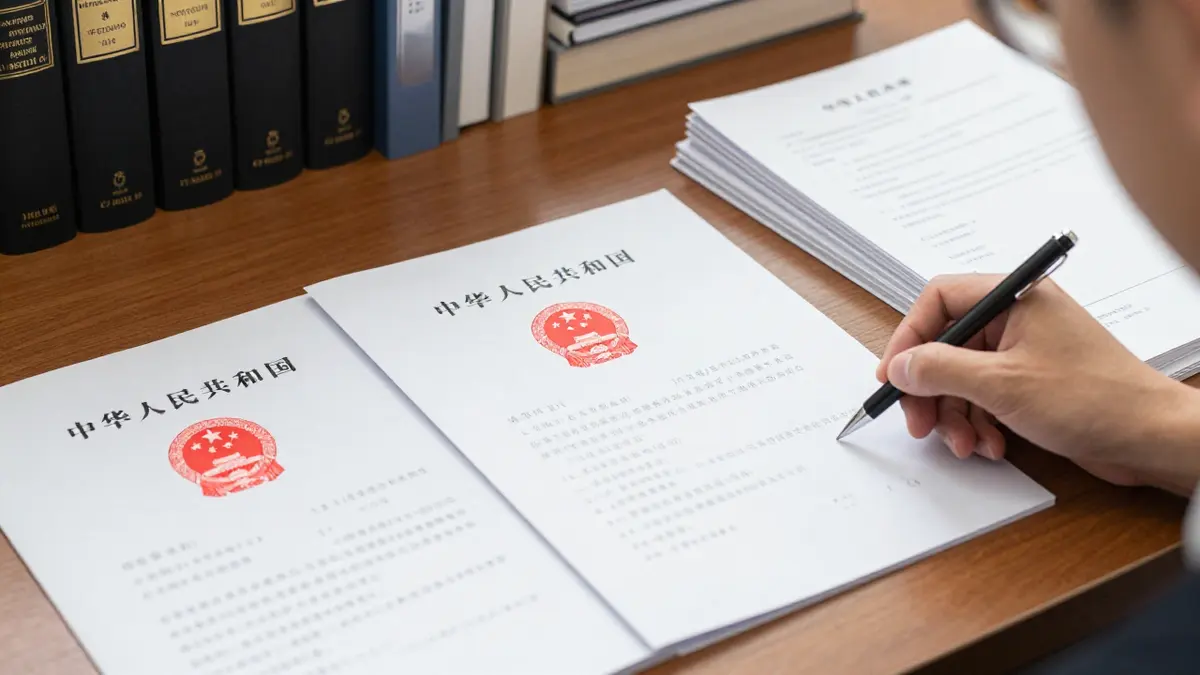

Work permits, entry visas, talent programs, and residence permits solve different problems. For a foreign professional, the employer must match the actual job and applicant to the correct work authorization process, while the employee must separately complete the entry and residence steps that apply to that case. An invitation or work-permit notification is not itself a visa or an open-ended right to work for any employer.
The paperwork has also changed: since 1 December 2024, work-permit information has been integrated with China’s social security card and online service system. Older checklists that tell every applicant to collect a separate physical work-permit card may be out of date. This guide lays out the core document set, the sequence to confirm with the competent local authority, and the records to keep when a job or passport changes.
1. Keep work authorization, visa, and residence status separate
Start by identifying the document each step is meant to obtain. A work-permit application establishes whether the person may take the proposed job for the named employer. A visa is used to seek entry under its stated conditions. A work-type residence permit is an immigration document for a person who will live in China for work. The Employment and Exit-Entry rules require foreigners working in China to obtain the prescribed work permit and work-type residence permit; a visa or talent label should not be treated as a substitute for those requirements.
For many longer assignments, the employer first seeks the appropriate work-permit notification. The applicant uses that and the other required materials to apply for the relevant work visa at a Chinese embassy or consulate. The notification letter is not itself a visa. After entry, complete the applicable work-permit and residence-permit steps with the authorities for the employer’s location and within the deadline stated in the current process. The State Council’s 2025 work-and-living guide describes a 30-day post-entry period for the residence-permit application in the covered cases.
Short assignments, specialized talent programs, and cases with a different immigration basis may follow different instructions. Confirm whether the proposed work is within a short-term procedure, what document authorizes it, and where it may be performed before booking travel or setting a start date. A family member’s dependent status does not by itself authorize employment.
2. Agree the job facts before assembling documents
The sponsoring employer and applicant should first reconcile the information that will appear across the work-permit application, contract or appointment letter, visa application, and residence documents:
- Employer’s exact registered name and the local office that will sponsor the application.
- Actual job title, duties, work location, start date, assignment length, and reporting line.
- Applicant’s legal name, nationality, passport number and expiry date, education, qualifications, and relevant work history.
- Whether the arrangement is direct employment, a secondment, an appointment, or a short-term service assignment.
- Any regulated profession, sector approval, or project-specific authorization connected to the work.
Use the real job and worksite. A title written to fit a category, while the contract and daily duties describe something else, can cause a request for more information or a problem during later inspection. If the employer, position, passport, work location, or other registered detail changes, ask the local work-permit office which amendment or new application is required before relying on the existing approval.
3. Applicant documents commonly requested
The national 2025 guide lists a core set of materials for a work-permit application. The precise checklist depends on the applicant’s category, role, employer, document-issuing country, and local service window, so use the current list in the official online system rather than treating the items below as a universal checklist:
- Completed work-permit application form and a valid passport or other accepted travel document.
- Evidence of work qualifications and relevant employment history.
- Highest degree certificate or other accepted education record, plus professional qualification documents where the role requires them.
- Certificate of no criminal record and a health-examination certificate, when required for that application.
- Signed employment contract, appointment certificate, or company dispatch letter that accurately describes the assignment.
- Recent photograph in the format requested by the system.
- Supporting records for accompanying family members, if family residence applications are also being made.
Check whether a foreign public document needs an apostille or another authentication procedure based on where it was issued, the type of document, and the applicable treaty route. Arrange an official Chinese translation where required. Names, dates, issuing bodies, passport numbers, employment periods, and degree titles should match across the original, translation, application, and contract. Keep scans legible and retain the original documents for any verification requested by the authority.
4. Employer documents and application ownership
The employer should control the application in the Service System for Foreigners Working in China or the current platform designated for its location. Before submission, verify the employer’s legal identity, the authority of the person filing, the job description, contract or appointment terms, and any supporting company or sector documents requested by that local service window. Agree in writing who will obtain each document, pay translation or authentication costs, submit the online application, respond to supplements, and tell the employee when travel can safely be arranged.
Keep the application number, submitted files, uploaded translations, authority requests, response receipts, notification, and decision in one case file. If a recruitment agent, payroll company, or overseas parent is involved, identify which entity is the actual Chinese employer and which entity is only an intermediary or sender. Do not let inconsistent entity names or a vague secondment description flow into the application.
5. Follow the post-entry and 2024 card-integration process
Since 1 December 2024, the Ministry of Human Resources and Social Security has integrated work-permit information with the social security card. Applications, extensions, changes, and cancellations are handled through the online work system; under the new process, a separate physical work-permit card is generally no longer issued after entry. The notice says existing physical permits follow a “no change, no replacement” approach until an extension or change is processed. Confirm how the approved work-permit information will appear in the applicant’s current electronic or card record for the location and application.
Do not confuse the card-format change with a change in the underlying permission. The employer must still secure the required work authorization, and the foreign employee must complete any required visa, work-type residence, and local registration steps. If the visa requires the holder to obtain a residence document after entry, the Exit-Entry Administration Law sets a 30-day application period. Confirm the applicable deadline from the visa and current instructions; calendar it from the actual entry date.
For accommodation, a hotel normally handles the foreign guest’s residence registration. If staying elsewhere, confirm how to complete the required registration with the local public-security authority. Keep proof of registration and copies of passport, visa, residence-permit application receipts, work authorization records, and the employer’s contact details.
6. Changes, expiry dates, and family applications
Make one person responsible for a calendar covering the work authorization, entry visa, residence permit, passport, and employment contract. Start renewal preparations early enough for the local authority’s current processing time. Before a role, employer, passport, or assignment changes, check whether the permit record, residence document, or both must be amended and what sequence the authority requires. Do not assume that a valid residence permit automatically updates the work authorization.
Family members need their own supporting civil-status and identity documents and the correct dependent visa or residence application. Their eligibility and document list should be checked separately from the employee’s work application. A dependent residence document is not permission to take a job; a family member who plans to work needs the appropriate work pathway in their own right.
Pre-submission checklist
- Confirm the actual employer, duties, location, term, work category, and responsible local authority.
- Check the current online checklist for the applicant’s case, including translation and document-authentication instructions.
- Match names, passport details, dates, degree records, experience, and employment terms across every file.
- Obtain the work-permit notification and follow the separate visa application instructions before travel.
- On arrival, follow the current work-permit, residence-permit, and address-registration steps; calendar each applicable deadline.
- After a change or extension, retain the updated work authorization and residence records and confirm that the employer’s file matches them.
Primary references
For the document list and post-entry sequence, see the State Council’s 2025 Guide to Working and Living in China as Business Expatriates. For the current card-integration process, see the Ministry of Human Resources and Social Security’s Notice on Integrating Foreigner Work-Permit Information with the Social Security Card. The statutory work and residence requirements appear in the National Immigration Administration’s Exit-Entry Administration Law of the People’s Republic of China.