
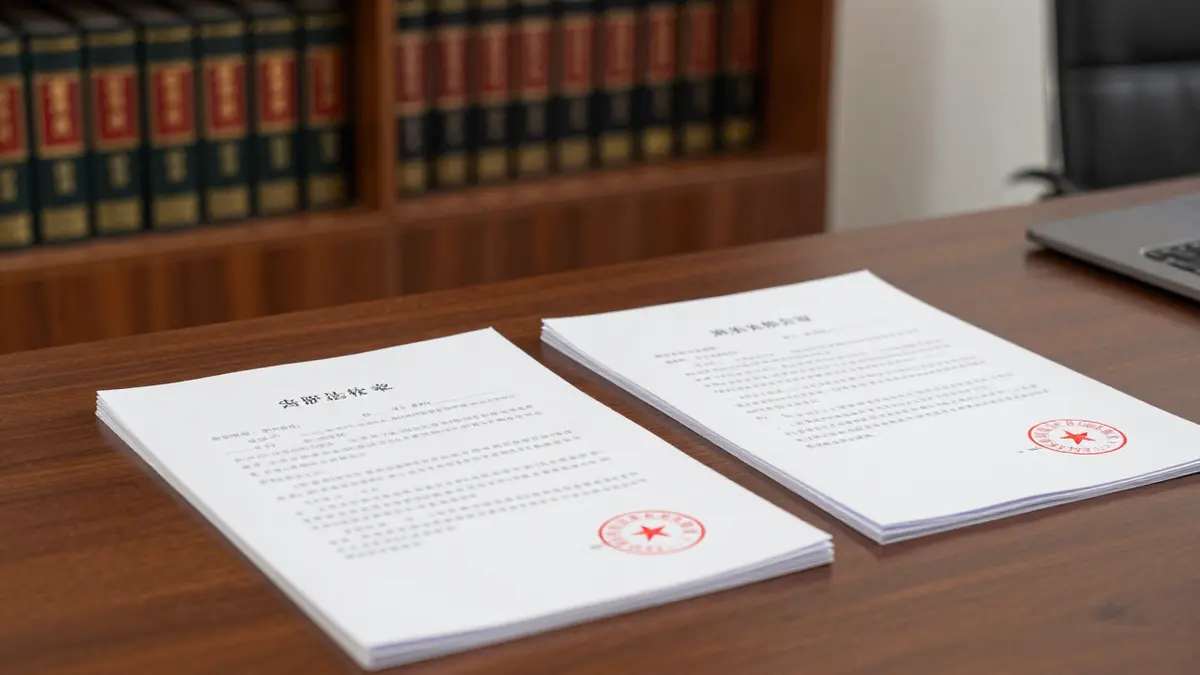
If you or your company have no domicile in China and receive a first-instance civil judgment or ruling, identify the appeal clock before relying on an internal calendar. The Civil Procedure Law gives a party without a China domicile 30 days from service to appeal; the ordinary periods are 15 days for a judgment and 10 days for a ruling. The legal test concerns the domicile of the named litigant, not simply nationality, passport, or where someone happened to be when the document arrived.
Then establish when service legally took effect. Preserve the decision, delivery record, and court service notice, and ask PRC counsel to confirm both the domicile test and service date. This guide turns those checks into a deadline-control process; it does not calculate a filing date for a particular case or replace advice based on the court record.
First identify the decision and the party
Use the decision served by the court, not an internal case summary. Record the issuing court, case number, named parties, whether the document is a first-instance judgment or ruling, and its service notice. The party deciding whether to appeal must assess its own domicile. A foreign parent, China subsidiary, shareholder, and director are separate litigants; one entity’s address or nationality does not answer the question for another.
Also check whether the procedure allows an ordinary second-instance appeal. The Civil Procedure Law makes some small-claims and special-procedure decisions final at first instance. If the decision says it is final, or the proceeding is unusual, ask PRC counsel to confirm the available route before relying on a standard appeal period.
Match the party and decision to the statutory clock
For ordinary civil cases, Article 171 sets these periods from service:
- First-instance judgment: 15 days to appeal.
- First-instance ruling: 10 days to appeal, if the ruling is appealable.
Article 286 provides a separate rule: a party with no domicile within the territory of China has 30 days from service of a first-instance judgment or ruling to appeal. An appellee with no China domicile has 30 days after receiving the appeal petition copy to respond. If a party cannot appeal or respond within the statutory period, it may apply for an extension, but the court decides whether to grant it.
Do not select the 30-day period just because a litigant is foreign, has an overseas passport, or received a document while abroad. Equally, do not assume a company has a China domicile merely because its affiliate, representative, lawyer, or service contact is in China. The question concerns the domicile of the party named in the case. Ask counsel to determine that status from the party’s legal identity and circumstances and record the conclusion in writing.
Find the legally relevant service event
The period runs from service of the judgment or ruling, not the date printed on it and not necessarily the date a manager first opens a forwarded copy. For parties without a China domicile, Article 283 lists service channels that can include a treaty method, diplomatic channels, the party’s litigation representative, specified entities or representatives in China, eligible postal service, electronic delivery where permitted, or another method to which the recipient agrees. If the listed methods cannot be used, service by public notice may apply; the statute provides that service is deemed made after 60 days from publication.
Build a service record for the method actually used. Preserve the complete decision and service notice, together with whichever items apply:
- postal or courier envelope, tracking history, receipt, and delivery certificate;
- court electronic notice, recipient account details, access or delivery log, and any confirmation;
- proof of service on counsel or another authorized recipient, including the appointment or designation relied on;
- the public notice and its publication date; or
- the court’s service record and correspondence confirming how delivery was completed.
Keep the original file and a simple chronology of dispatch, delivery, access, forwarding, and escalation to counsel. A screenshot showing when an employee read a message may help reconstruct events, but it does not by itself decide when service took legal effect. Ask counsel to check the court’s record and the legal effect of the method used.
Use a two-part deadline check
- Confirm the rule: identify the exact litigant, whether it has a domicile in China, the kind of first-instance decision, and whether an appeal is permitted. Ask counsel to cite Article 171 or Article 286, or identify a special rule.
- Confirm the trigger: identify the legally effective service event and date from the court record. Ask counsel to calculate the deadline under the applicable procedural rules, including treatment of the final day.
Enter the counsel-confirmed deadline in the case calendar and set an earlier internal target. Assign one person to monitor service messages and another to verify the date with counsel. If more than one party may appeal, calculate separately for each party; their domicile status and service dates may differ.
If the party is an appellee, open a second deadline when the appeal petition copy is served. Article 286 gives an appellee without a domicile in China 30 days to respond. Do not reuse the appellant’s date: the response period begins on receipt of the appeal copy.
If the date is uncertain or the period may have passed
Send counsel the decision, all delivery evidence, the party’s identity and domicile records, and any earlier service correspondence. Ask the court for the service record where needed. Do not choose a later date solely because the document circulated internally after delivery, and do not rely on an extension request unless the court grants it.
The Civil Procedure Law states that a first-instance judgment or ruling that is not appealable, or is not appealed within the applicable period, becomes effective. If a deadline may have expired, ask counsel promptly to assess the legal effect and any procedure that might remain available. A later procedure is not an automatic substitute for a timely appeal.
Primary legal source
Civil Procedure Law of the People’s Republic of China (2023 amendment), Articles 158, 171, 283, and 286, published by the Supreme People’s Court Intellectual Property Court. The text of the statute and the service record in the individual case control.
This is general information, not a deadline calculation for a particular case. PRC litigation counsel should confirm the party’s domicile, appealability, service method, effective service date, and final filing date.