
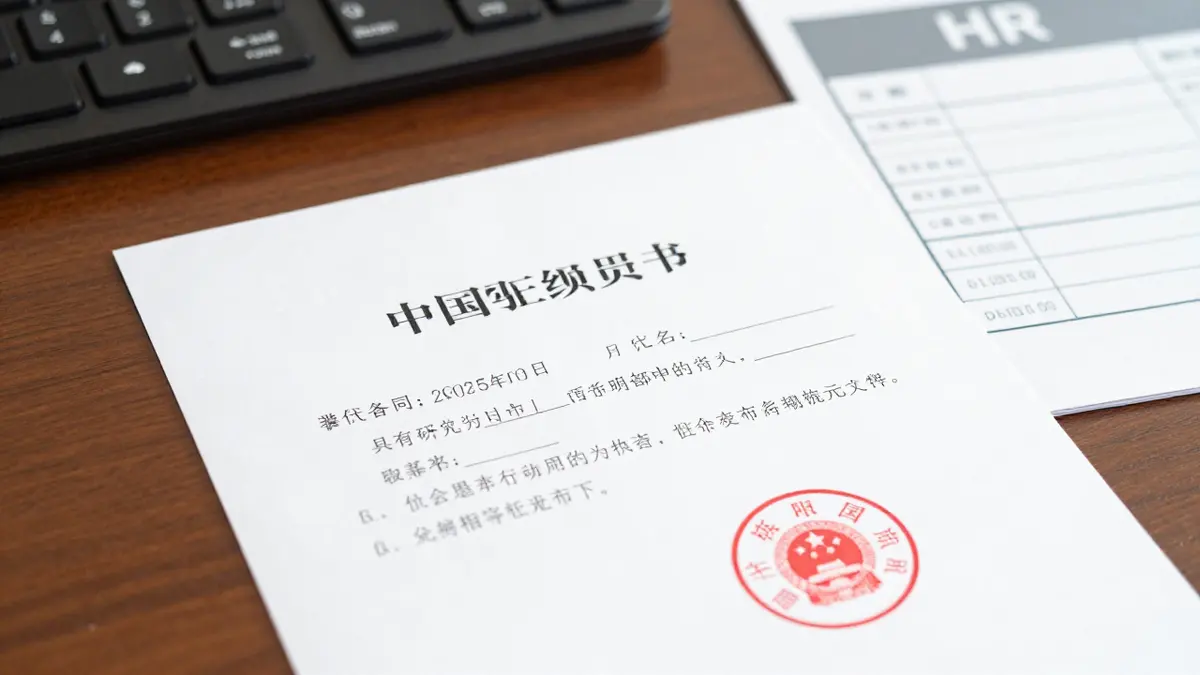
Before preparing a divorce filing in China, separate three questions: whether a Chinese court may hear the dispute, which city has territorial venue, and which level of court should take the first filing. These questions can turn on different facts. A defendant’s residence, each spouse’s nationality, whether either spouse has settled abroad, and any proceeding already filed elsewhere should be checked before choosing a courthouse.
This checklist helps organize those facts for legal review. The general defendant-domicile rule and the Supreme People’s Court’s special provisions for some Chinese citizens and overseas Chinese do not create a single venue rule for every foreign-national couple. Residence permits, marriage registration location, or an address alone should not be treated as a guaranteed answer.
First separate international jurisdiction from local venue
A case may have a connection to China and still require a separate analysis of which Chinese court can hear it. If a Chinese court can hear the case, territorial venue asks which location’s court is the proper place to file. Court level is another question: the Civil Procedure Law assigns major foreign-related civil cases to intermediate courts, and the Supreme People’s Court’s interpretation describes factors such as the amount in dispute, complexity, number of parties, or broader impact. The presence of a foreign national alone does not answer all three questions.
Build a residence and nationality timeline for both spouses
For each spouse, write down nationality or nationalities, registered domicile, current country and city, the date residence began there, and any move during the year before a proposed filing. Also record whether the person has settled abroad or is temporarily overseas. For the marriage, note where it was registered and whether either spouse has filed a divorce or related case in another country. A dated timeline is more useful than simply listing current addresses.
Under the ordinary territorial rule in Article 22 of the Civil Procedure Law, a civil case against a citizen is generally heard at the defendant’s domicile; when domicile and habitual residence differ, the habitual-residence court is the general venue. The Supreme People’s Court’s interpretation defines habitual residence as a place where a person has continuously lived for at least one year after leaving their domicile, excluding a place of hospitalization. That is a factual legal test, not an automatic result of holding a residence permit.
Check the separate rules for spouses who have moved away
Article 12 of the Supreme People’s Court’s Civil Procedure Law interpretation addresses specific situations where one or both spouses have left their domicile for more than a year. If one spouse has left for more than a year and the other files for divorce, the plaintiff’s domicile court may hear the case. If both have left their domiciles for more than a year, venue is generally the defendant’s habitual-residence court; if there is no habitual residence, the interpretation points to the defendant’s place of residence when the plaintiff files. Confirm the exact dates and locations before relying on this route.
Do not extend overseas-Chinese provisions to every foreign national
Articles 13 to 16 of the interpretation address particular situations involving overseas Chinese or Chinese citizens abroad. They include cases where an overseas court refuses a divorce case on a specified jurisdictional ground, where one Chinese citizen lives abroad and the other in China, and where both Chinese citizens are abroad but have not settled there. The provisions identify Chinese connecting places such as the place of marriage, a party’s original domicile, a last domestic residence, or the domestic spouse’s domicile, depending on the specific scenario.
Those provisions are fact-specific. They should not be presented as a general rule that every foreign spouse can file where they hold a Chinese residence permit, where the couple registered a marriage, or where one spouse once lived.
Check foreign-related proceedings before choosing the filing route
Ask whether either spouse has already filed abroad, received a foreign order, or signed a settlement that addresses the marriage or related claims. Article 280 of the Civil Procedure Law addresses cases where the same dispute is filed in China and abroad, including circumstances in which a Chinese court with jurisdiction may accept the case and situations in which the proceedings may be coordinated. A filing history can therefore affect the analysis and should be disclosed at the start.
Article 276 provides connecting-factor jurisdiction for certain foreign-related cases against a defendant without a domicile in China, but expressly limits that provision to claims other than personal-identity disputes. It should not be used as a general “substantial connection” shortcut for a divorce claim.
Prepare a court-selection file, not just a document bundle
- Passports or other identity records and each spouse’s nationality history.
- Registered domicile and dated evidence of where each person has actually lived, including move dates.
- Marriage record and place of registration, with existing translations or formalities recorded rather than assumed complete.
- Any foreign court filing, order, service notice, or agreement relating to the marriage or children.
- A short list of the Chinese court locations under consideration and the specific rule or connecting fact for each.
Ask counsel to confirm international jurisdiction, territorial venue, court level, and service arrangements as separate items. The right place to file depends on the parties’ status, residence history, and prior proceedings; this general checklist does not determine jurisdiction in a particular case.
Primary references: Civil Procedure Law of the People’s Republic of China (2023 revision), Articles 22, 23, 19, 276, and 280; Supreme People’s Court Interpretation on the Civil Procedure Law (2022 revision), Articles 1, 3–4, and 12–16.