China’s Patent Law allows a court to use a patent royalty as a reference when the right holder’s actual loss or the infringer’s gain is difficult to determine. A license fee can help quantify damages, but only if the agreement is meaningfully comparable to the patent and use at issue.
In a Supreme People’s Court patent case, the license covered a bundle of 51 patents and applications. The Court said the bundled rate did not, by itself, support treating a divided per-patent amount as the rate for the single patent in suit. The record must explain what the license covers and why its economics fit the alleged use.
Where a royalty fits in the damages analysis
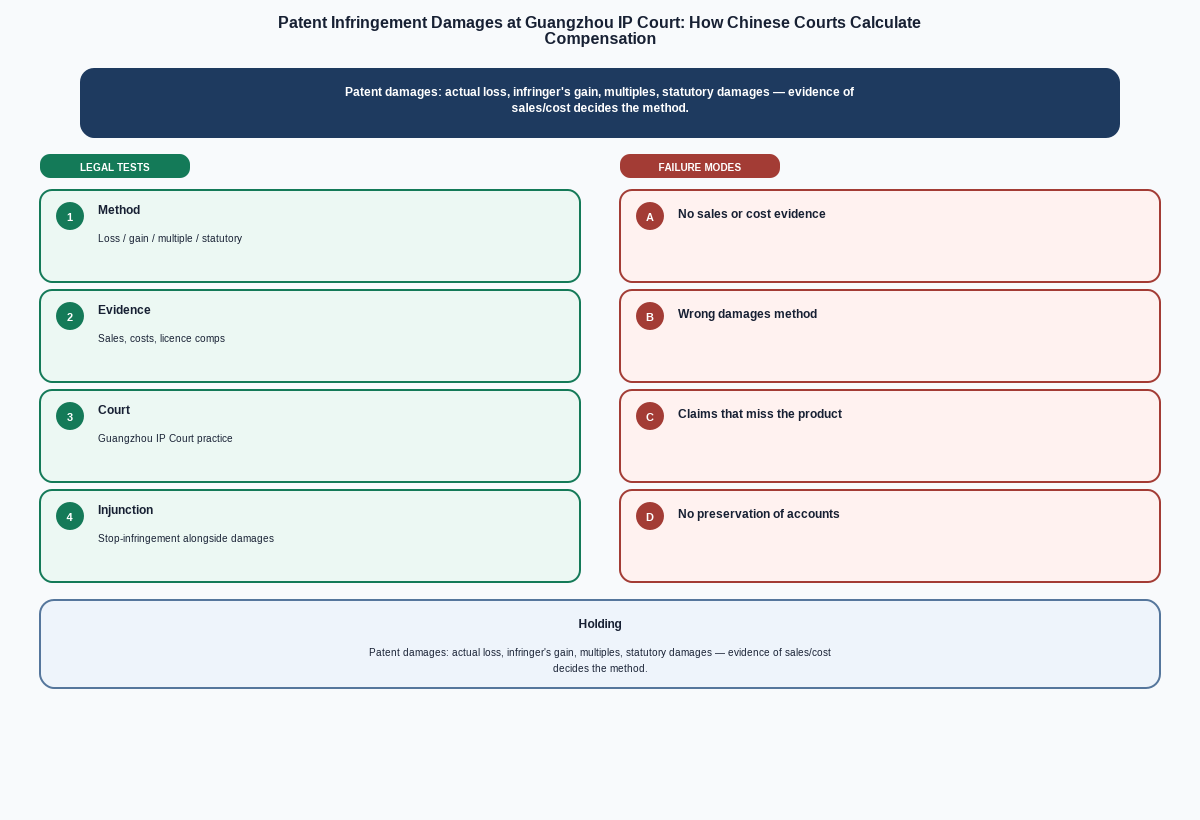
Patent Law Article 71 identifies actual loss to the right holder or the infringer’s gain as bases for infringement compensation. If those amounts are difficult to determine, the court may reasonably refer to a multiple of the patent’s license royalties. If loss, gain, and a reference royalty are all difficult to determine, the law allows statutory compensation within its stated range. Reasonable expenses paid to stop the infringement are also included in the compensation amount.
A royalty is therefore a comparison point that needs evidentiary support. The agreement’s headline payment alone does not show what use was priced, which rights were licensed, or whether the accused product and time period are comparable.
A portfolio fee is not automatically a single-patent rate
In Supreme People’s Court case (2022) Zui Gao Fa Zhi Min Zhong No. 817, a party relied on a fee associated with a package of 51 patents and patent applications. It argued for using a per-unit amount from that package as the fee for the single patent at issue. The Court said the package fee did not provide a sufficient basis for that per-patent figure. It also considered other evidence, including product quantities, when deciding whether the total damages awarded were plainly unfair.
The practical point is limited but important: dividing a portfolio price by the number of listed patents does not, without more, establish a comparable royalty for one patent. The package may price a collection of rights, applications, products, or commercial terms together. A damages submission should explain the allocation rather than assume the arithmetic supplies one.
Show what the license actually covers
Submit the complete agreement and its schedules, amendments, and payment records where available. Identify the licensed patent numbers and status, products, territory, term, permitted activities, exclusivity, and any portfolio or standard-essential-patent terms. Explain whether the fee is a lump sum, running royalty, minimum guarantee, or part of a broader settlement or commercial arrangement.
Then connect the agreement to the infringement evidence. Identify the accused products and sales period, the patent features used, and any differences between the licensed and accused use. If the fee covers several patents, show a reasoned allocation supported by the contract or commercial record. If the evidence does not permit a reliable allocation, say so and explain which other damages evidence is available.
Use the statutory factors to test comparability
The Supreme People’s Court’s patent-dispute provisions identify the type of patent, the nature and circumstances of the infringement, and the license’s nature, scope, and time as relevant when using a royalty multiple. These factors help test whether a proposed agreement is a useful comparator, not just whether the same technology sector appears in both matters.
For example, a license for a broad portfolio over a long period may not map cleanly to one patent and a shorter alleged infringement period. A settlement payment that resolves several disputes may not be a patent license at all. Describe the differences, explain which adjustments can be supported, and avoid presenting a negotiated package price as a market rate without its surrounding terms.
Keep a separate record for each damages method
Even when seeking a royalty-based amount, preserve evidence of the right holder’s sales and margins, the defendant’s product quantities and revenue, and the accused product’s contribution to value. These materials may support another statutory method or help the court evaluate a proposed royalty comparison. If relevant sales books and records are mainly held by the defendant, Patent Law Article 71 allows the court, after the right holder has tried its best to provide evidence, to order production; refusal or false records may allow the court to refer to the claimant’s evidence.
Keep the calculation transparent: list the source for each figure, the period covered, the products counted, the patent or portfolio scope, and any allocation or adjustment. Ordinary compensatory damages and a request for punitive damages raise distinct legal requirements. This article focuses on the evidence for a royalty comparison; the controlling Chinese text, the full agreement, and the facts of the case should be reviewed by China patent counsel. See the official Patent Law and the Supreme People’s Court’s patent judgment in case (2022) Zui Gao Fa Zhi Min Zhong No. 817.