
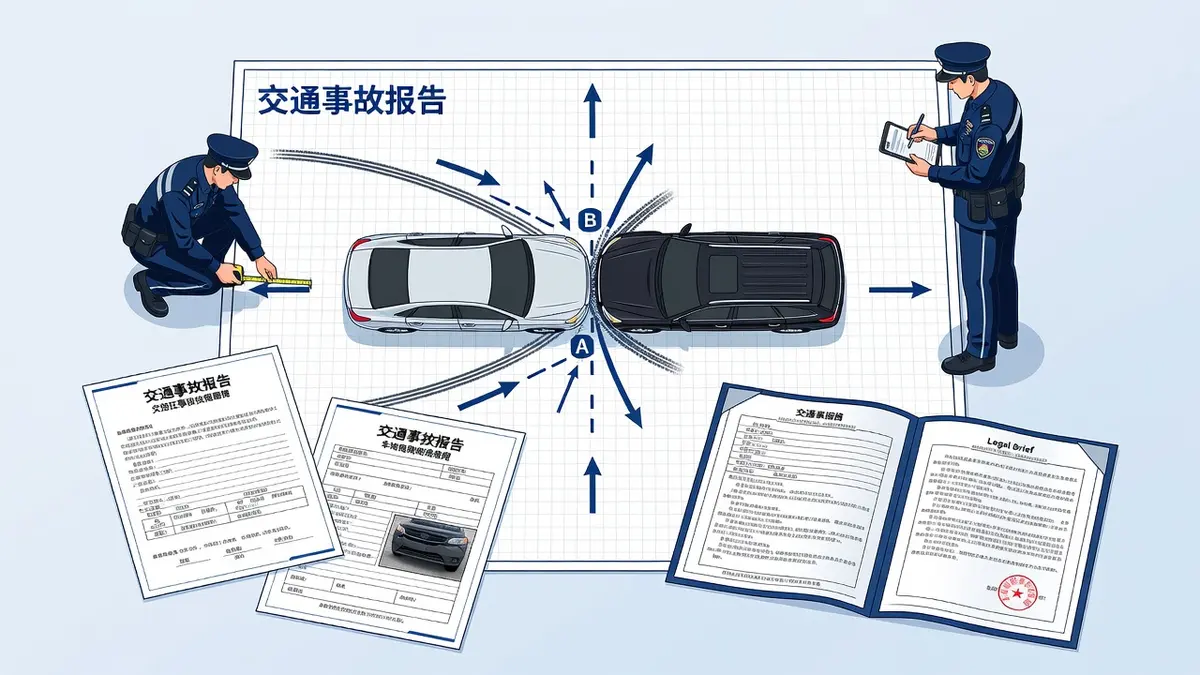
A free lift from a colleague, friend, or host can end in a serious crash. If you were injured while riding in a privately used vehicle in China, the driver’s offer to help does not automatically erase responsibility. But a special Civil Code rule may reduce the driver’s compensation liability when the ride was gratuitous and the driver was not intentionally or grossly negligent.
The key questions are whether this was truly a free ride in a non-commercial vehicle, what caused the crash, and what the driver did before impact. Since June 30, 2026, a Supreme People’s Court interpretation has addressed how courts assess this defense. Here is how to preserve the record, check the short review deadline for a police accident determination, and organize an injury claim.
Start with the kind of ride
Article 1217 of the PRC Civil Code applies when a non-commercial motor vehicle causes injury to someone it carried for free, and responsibility lies with that vehicle’s side. The driver can ask to have compensation reduced. The reduction is unavailable if the driver acted intentionally or with gross negligence.
This is a fact-specific rule, not a blanket immunity for a friend who gives a lift. It does not automatically govern a taxi, paid ride-hailing trip, charter, or other commercial transport. A shared-cost or mixed-purpose arrangement may need closer analysis: the label “free ride” is not decisive by itself. Keep messages about why the trip happened, whether money changed hands, the route, and any arrangement with the driver. If another vehicle, employer, or transport operator contributed, identify that separately.
What the driver must show
The driver’s traffic-fault percentage and the passenger’s civil compensation claim answer related but different questions. A police determination that the driver bears all or most responsibility does not by itself prove that the driver was grossly negligent toward the passenger. The Supreme People’s Court’s 2026 interpretation directs courts to consider the accident determination together with how the crash happened and the driver’s specific conduct when deciding whether the exception applies.
The Court’s published example involved a driver who fell asleep after lunch while carrying a co-worker for free. Although the driver was found fully responsible for the single-vehicle crash, the court found no proof of intentional or grossly negligent conduct and reduced the driver’s compensation share to 80 percent. That result illustrates the separate inquiry; it is not a fixed percentage for other cases. Facts such as knowingly continuing to drive while dangerously drowsy, intoxication, or deliberate dangerous conduct may matter, but no single label automatically resolves the legal test.
Ask the driver to identify the legal and factual basis for a reduction. Preserve evidence that speaks to the moments before impact: driving time and rest, route and speed, road and weather conditions, dashcam or nearby-camera footage, passenger messages, witness details, and any available phone or vehicle records. Do not edit original files; keep the source device and record when and how each copy was obtained.
Check the accident determination quickly
Call 120 for emergency medical help and 122 for traffic police where appropriate. A driver involved in a crash causing injury must stop, protect the scene, arrange rescue, and report the accident. Do not delay medical care to collect evidence. If urgent rescue changes the scene, record what was moved and why when it is safe to do so.
The traffic police investigate and issue an accident determination describing the basic facts, cause, and each party’s responsibility. It is evidence in later proceedings, not the final calculation of the passenger’s civil damages. Read the Chinese document carefully. Check the location, parties, vehicle, sequence of events, cited evidence, and any statement that you contributed to the crash.
If you disagree with the determination or an accident certificate, the Road Traffic Accident Handling Procedures Provisions allow a written review request within three days after it is served. State what conclusion you challenge, why, and the main evidence supporting the request. The same accident can be reviewed once. Because the period is short, get a qualified local lawyer to review the notice and filing route promptly; do not assume a later compensation lawsuit replaces this review procedure.
Build the injury and payment record
Keep the medical record from the first examination through follow-up care, prescriptions, invoices, rehabilitation instructions, transport to treatment, time away from work, income records, and any disability assessment. Create a dated ledger showing each expense, who paid it, and whether it was reimbursed. Ask the provider to explain the medical need for future care or rehabilitation in the records rather than relying on a later summary alone.
Check insurance by policy and by vehicle. Compulsory motor liability insurance generally covers people outside the insured vehicle; the compulsory-insurance regulation excludes people riding in that same vehicle. Do not assume the host vehicle’s compulsory policy pays its own passenger. Ask for the policy details for every involved vehicle, check any commercial coverage and its terms, and separately review travel, personal-accident, or employer insurance. Civil Code Article 1213 sets the general order of compulsory insurance, commercial motor insurance under its contract, and the responsible tortfeasor where the statutory and policy coverage applies.
The Supreme People’s Court’s 2026 interpretation also bars duplicate recovery from the tortfeasor for medical costs already paid by basic medical or work-injury insurance, or emergency costs advanced by the Road Traffic Accident Social Assistance Fund. Record those payments and any fund advance clearly; do not list an already-paid bill as an unpaid personal loss. The interpretation took effect on June 30, 2026, and applies to cases not yet finally concluded on that date.
A focused file for the first week
- Confirm whether the vehicle was non-commercial and whether the ride was genuinely gratuitous.
- Write a time-stamped account of the trip, crash, rescue, and the driver’s conduct beforehand.
- Preserve messages, original photos and video, witnesses, medical records, receipts, and work-loss proof.
- Obtain the accident determination and calendar the three-day written-review deadline from the date it is served.
- List each involved vehicle and policy; distinguish the host vehicle’s own passenger from third parties covered by compulsory insurance.
- Track what the driver, insurer, health plan, employer, or rescue fund has already paid.
- Before signing a full-and-final release, check whether it addresses future treatment, disability assessment, outstanding bills, and every payer’s recovery rights.
Primary sources
- PRC Civil Code, Articles 1179, 1213, and 1217.
- Supreme People’s Court Interpretation II on Road Traffic Accident Compensation, effective June 30, 2026, Articles 3, 10, and 12.
- Supreme People’s Court published traffic-accident cases, including the free-ride case discussed above.
- Road Traffic Safety Law, Articles 70, 73–76.
- Road Traffic Accident Handling Procedures Provisions, Articles 64, 71, and 74.
- Compulsory Motor Vehicle Traffic Accident Liability Insurance Regulations, Articles 3, 21, and 24.
This overview concerns the PRC mainland legal framework and is not advice on a specific accident. The applicable evidence, insurance, and civil-liability analysis depends on the facts and the policy wording.