
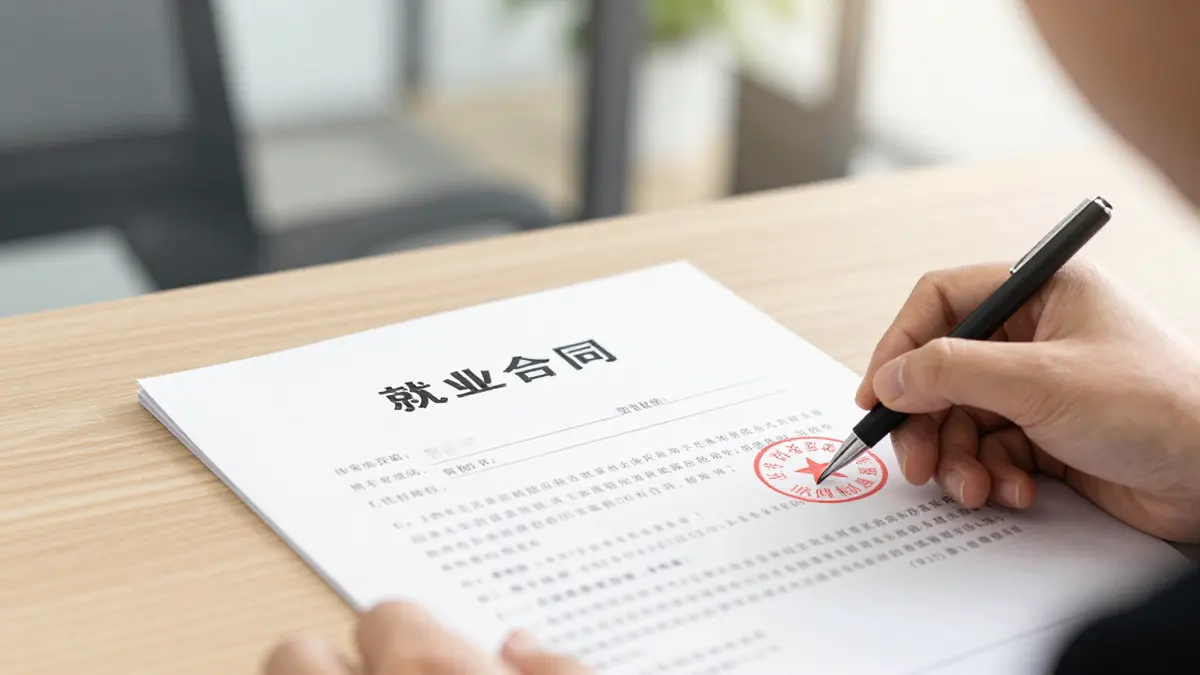
A dismissal dispute usually turns on the reason the employer actually relied on and whether it followed the procedure attached to that legal ground. A termination notice, policy, performance record, and payroll document can point in different directions. Before debating a payout, identify the route stated in the notice and compare it with the facts and records that existed when the decision was made.
For a foreign employee, first confirm which entity signed the labor contract and whether the employment relationship is governed by mainland China labor law. Keep the employment-permit and residence-permit questions separate from the labor claim: one does not automatically decide the other. The checklist below is a way to organize a dispute for advice and arbitration, not a prediction that every dismissal is unlawful.
Start with the written reason
Save the termination notice in its original form, including its date, delivery method, attachments, and the name of the entity that issued it. If the employer first announced the decision in a meeting or messaging app, make a dated note and preserve the original messages. Ask for the formal reason and effective date in writing. Do not alter records or remove confidential business files from company systems.
Then compare the stated reason with earlier warnings, investigation notices, performance plans, meeting minutes, and the employment contract. A later explanation may differ from the reason given at dismissal. Record that difference rather than trying to resolve it by rewriting the timeline.
Identify the statutory route
China’s Labor Contract Law uses different routes for different reasons. Article 39 covers specified employee-fault grounds, including serious violation of lawful workplace rules and serious dereliction causing major loss. Article 40 covers three non-fault situations, such as continued inability to perform after training or reassignment. For an Article 40 dismissal, the employer must give 30 days’ written notice or pay one additional month of salary. Economic layoffs under Article 41 have a separate threshold and consultation and reporting steps. A general statement that the company is “restructuring” does not by itself identify which route it used.
For each route, ask what must be proved and by whom. For a policy-based dismissal, collect the policy version in force, evidence it was adopted and communicated, the specific conduct alleged, and any investigation record. For a performance or inability-to-work ground, preserve role expectations, reviews, training or reassignment records, and the employer’s response to any proposed adjustment. For a layoff, note the headcount calculation, stated economic basis, consultation materials, selection criteria, and filing or reporting record.
Article 43 separately requires an employer intending to terminate a contract unilaterally to notify the trade union of its reasons in advance; where a trade union objects to a legal or contractual violation, the employer must consider the opinion and notify the union of the outcome in writing. Check whether this step applied and whether there is a record of it. It is one procedural issue in the analysis, not a substitute for checking the legal ground and evidence.
Check whether a protected-period rule applies
Article 42 limits an employer’s ability to use the non-fault termination routes in Articles 40 and 41 for specified workers and circumstances, including a statutory medical-treatment period, pregnancy, childbirth and nursing, and certain occupational-disease or work-injury cases. The law does not describe every termination during such a period as automatically void: the exact ground and facts still matter. Preserve medical, leave, occupational-health, or work-injury records and the dates on which the employer knew of them.
Build a short evidence map
Organize the record by issue rather than sending a large, unlabelled archive. A practical index can list: (1) the employer’s stated ground and notice; (2) the rule, instruction, or performance standard relied on; (3) what happened and when; (4) any required consultation, union notice, or layoff procedure; (5) salary and length of service; and (6) the outcome requested. Keep contracts, amendments, payslips, bank records, attendance data, performance reviews, policy acknowledgments, and relevant messages in their original context.
The Labor Dispute Mediation and Arbitration Law places a specific burden on the employer when evidence relevant to a dispute is controlled by the employer: if the employer does not provide it, the employer bears the adverse consequence. Identify the particular document and why it matters; do not assume that a general request will obtain every internal record. Keep a copy of each evidence submission and proof of delivery.
Choose the remedy and calculate it separately
Article 48 provides that when an employer unlawfully terminates a labor contract, it must continue performing the contract if the worker requests continued performance. If the worker does not request that remedy, or continued performance is impossible, the employer must pay compensation under Article 87. That compensation is calculated by reference to the economic-compensation standard in Article 47, commonly described as double compensation or “2N.” It is not an automatic amount for every disputed dismissal.
For a separate economic-compensation calculation, Article 47 generally uses one month of the worker’s average monthly salary for each full year of service, with statutory treatment for partial years. Where the statutory high-salary threshold is met, the salary base and years counted are capped as the article specifies. Keep the start date, prior service records, and the 12 months of wage records before termination; verify the applicable local average-wage figure before calculating. Ordinary severance under Articles 46–47 and Article 87 compensation are different legal outcomes, so label the requested remedy clearly.
Track arbitration and immigration steps on separate timelines
The general limitation period for applying for labor arbitration is one year from when a party knew or should have known its rights were infringed. The law has interruption and suspension rules, and a special rule for certain unpaid-wage claims during an ongoing labor relationship. Do not rely on informal negotiations to preserve a deadline without checking the facts. Labor disputes generally go through arbitration before a court claim, subject to the statutory exceptions.
Foreign-national employment can require an additional threshold review. The Ministry of Justice’s published guidance says that Chinese labor law applies where a foreigner holding the required employment certificate works wholly in mainland China for a domestic employer and establishes a labor relationship; other arrangements need fact-specific review. Confirm the contracting employer, work location, permit records, and any dispatch or overseas-employer structure before naming respondents. Separately ask the relevant immigration authority or counsel about work-permit cancellation, a new employer, and residence status. Do not assume that a labor arbitration filing itself extends immigration permission.
Prepare the claim around the decision record
A focused claim file should state the termination date, the exact reason given, the statutory route that appears to apply, the evidence supporting or contradicting that reason, the procedural steps in question, and the remedy requested. If an employer offers a settlement, compare the written amount and payment date with the remedy being considered, identify any unpaid wages or other separately claimed sums, and keep a signed copy. Have a bilingual agreement reviewed before signing if the versions differ.
This guide is general information. Local practice, the employer’s legal identity, the evidence available, and the worker’s immigration status can change the analysis. A qualified labor-law professional can assess those facts and confirm the filing forum and deadlines.
Primary legal sources: Labor Contract Law, Articles 39–41; Articles 42–47; Articles 48–50; Labor Dispute Mediation and Arbitration Law, including Articles 6, 27, and 28; Ministry of Justice guidance on labor-law coverage for foreign employees.