
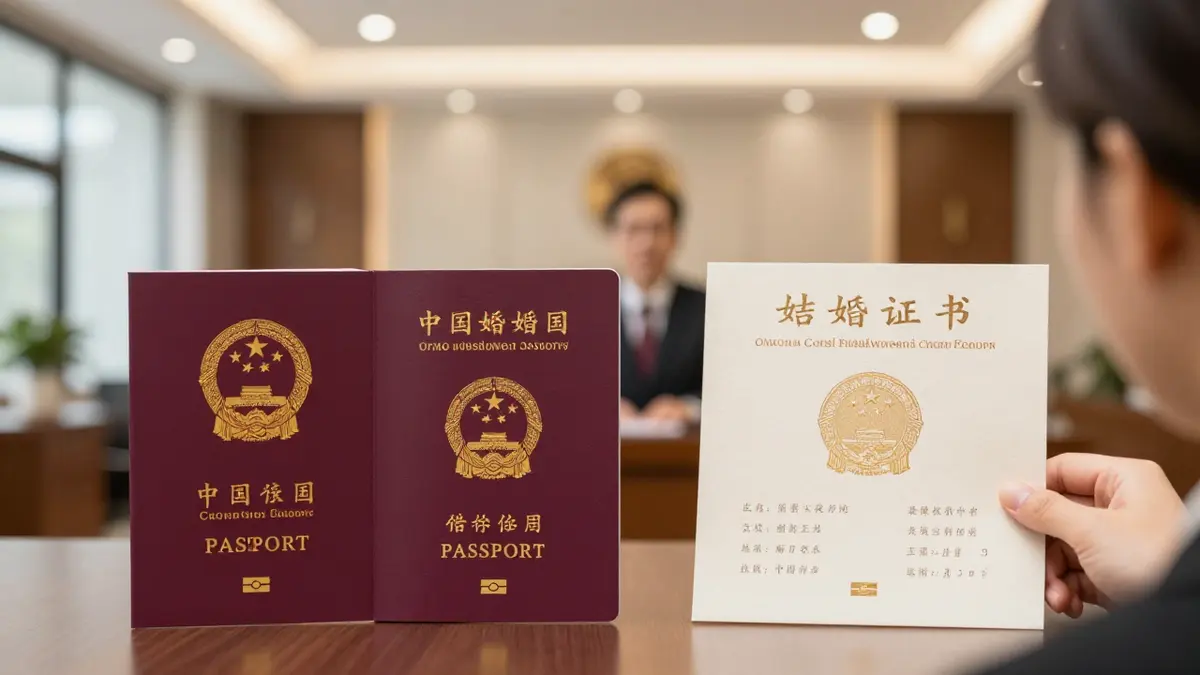
An international marriage does not by itself answer which country’s law classifies spouses’ assets as marital or separate. China’s Law on the Application of Laws to Foreign-Related Civil Relationships sets a specific rule for spousal property: the spouses may choose among several connected laws; without a choice, their common habitual-residence law applies, and if they have no common habitual residence, their common national law applies. This governing-law question is separate from where a divorce is filed, what a property register shows, and whether an order can be enforced where an asset is located.
This guide explains that choice-of-law sequence, the records that help identify and trace property, and the limits of drawing conclusions about overseas assets. It does not cover divorce registration or recognition of a foreign divorce; see the guides to cross-border marriage and divorce registration and recognition of foreign divorce judgments.
Start by identifying the legal question
A foreign element can arise from a spouse’s nationality or habitual residence, an asset located abroad, or a relevant event outside China. That fact does not mean every issue is governed by the same country’s law. A court may need to distinguish the marital property relationship between spouses from the divorce itself, ownership or registration of a particular asset, creditor rights, and recognition or enforcement of a judgment abroad.
For spouses’ property relationship, Article 24 of China’s Law on the Application of Laws to Foreign-Related Civil Relationships supplies the principal choice-of-law rule. It should be considered before assuming that the place of marriage, a spouse’s current address, or the name on an account decides the governing law.
Article 24: the order for choosing applicable law
Spouses may agree to apply the law of either spouse’s habitual residence, either spouse’s country of nationality, or the place where their principal property is located. If they made no choice, the law of their common habitual residence applies. If they have no common habitual residence, the law of their common country of nationality applies.
The relevant facts can change over time. Assemble the marriage and any property-agreement dates, each spouse’s nationality and habitual residences, and where the principal property was located when the agreement or dispute arose. Do not assume that a marriage certificate issued in China automatically makes Chinese law govern every property issue, or that a move abroad automatically changes the governing law.
If a foreign law is applicable, Article 10 says the people’s court, arbitral body, or administrative organ ascertains that law; a party who chose a foreign law must provide it. If the foreign law cannot be ascertained or contains no relevant provision, Chinese law applies. In practice, ask early what translated legislation, expert explanation, or other material the decision-maker will accept, and who is responsible for obtaining it.
Keep property classification separate from the divorce forum
Article 27 provides that a court-decided divorce is governed by the law of the forum. Article 26 separately addresses consensual divorce. Those provisions address the divorce route; Article 24 separately addresses spouses’ property relations. A forum rule for deciding whether to grant a divorce does not, by itself, answer how each asset is classified or whether a resulting order can change a foreign register.
Likewise, the law that determines the spouses’ internal property rights may not resolve every issue involving a specific asset. Article 36 provides that rights in rem in immovable property are governed by the law of the place where the property is located. Where a foreign home or other overseas land is involved, classification between spouses, registered title, court authority, local transfer formalities, and enforcement may require separate analysis. Do not assume that a China divorce judgment alone will transfer title abroad or be recognized there.
If Chinese marital-property rules apply
The Civil Code provides a default community-property regime unless the spouses have a valid agreement or another applicable rule changes the analysis. Article 1062 includes wages and other remuneration, production and business income, investment returns, intellectual-property income, and most property inherited or received as a gift during marriage. Article 1063 identifies separate property, including premarital property, compensation for personal injury, and an inheritance or gift that a will or gift contract specifies belongs only to one spouse.
Under Article 1065, spouses may make a written agreement that premarital property, property acquired during marriage, or both will be held separately, jointly, or partly each way. Keep the complete signed agreement and any later amendments. If it was made in another country, preserve the original and ask whether a translation or evidence of the law governing the agreement is needed.
These categories do not mean every asset bought during marriage is divided equally in every divorce. Article 1087 says spouses first handle community property by agreement. If they cannot agree, the people’s court decides according to the specific circumstances, with the statutory principles of protecting the interests of children, the woman, and the party without fault. The Supreme People’s Court’s 2025 Interpretation II also addresses particular disputes over transfers or gifts of housing and contributions by parents; it does not create a universal equal-split formula.
Trace the money, the agreement, and the asset
Prepare an asset schedule before negotiating or filing. For each item, record its location, legal owner shown in the relevant registry, date and price of acquisition, source of the purchase funds, any loan or lien, and the law or agreement you believe governs it. Mark what is undisputed and what needs evidence.
- For property held before marriage, keep dated purchase, title, valuation, and payment records.
- For inheritances and gifts, keep the will or gift instrument, probate or transfer records, bank statements, and any language specifying that the transfer is for one spouse only.
- For an asset bought during marriage, trace deposits and payments from their source. Retain account statements, closing papers, share registers, tax records, and loan documents.
- For a marital-property agreement, preserve the signed original, amendments, execution date, and any advice or translation used by both spouses.
- For assets or records held abroad, identify the institution or registry, the local procedure for obtaining certified records, and the translation or authentication steps the relevant court may require.
These records help identify the issue; they do not guarantee that a court can compel production from an overseas institution or decide title under another country’s law.
Debts and concealed assets need their own analysis
Under Civil Code Article 1064, debts jointly signed or later ratified by both spouses, and debts one spouse incurs in their own name for ordinary family needs, are generally community debts. A debt above ordinary family needs is not community merely because it arose during marriage; the creditor may need to establish that it served joint family life, joint business activity, or reflected both spouses’ intent. Article 1089 addresses repayment of community debts at divorce.
Article 1092 permits a court, in specified circumstances involving concealment, transfer, disposal, destruction, waste of community assets, or fabricated community debt, to award the offending spouse a smaller or no share when dividing community property. It is not a substitute for proving what an asset is, which law governs, and what happened to it. Keep a dated record of unexplained transfers and discuss lawful ways to preserve evidence before confronting the other spouse.
Questions to resolve before signing a settlement
- Which country’s law applies to the spouses’ property relationship under Article 24, and what facts establish the relevant habitual residence, nationality, or principal-property location?
- Is there a written property agreement, and does it cover the specific asset, time period, and type of income or debt?
- For a foreign home or business interest, what separate local title, transfer, tax, creditor, or enforcement rules apply?
- What records are missing, and what steps can lawfully obtain them before assets are transferred or a settlement is signed?
- Will any divorce, property, or debt order need recognition or enforcement in another country?
Answering these questions early can prevent a settlement from treating all property as if it were in one country under one set of rules. For case-specific advice, the relevant lawyer may need to coordinate Chinese conflict-of-laws analysis with counsel in each country where a principal asset or proceeding is located.
Sources: Law of the People’s Republic of China on the Application of Laws to Foreign-Related Civil Relationships, Articles 10, 24, 26, 27, and 36; Civil Code of the People’s Republic of China, Articles 1062–1065, 1087–1089, and 1092; Supreme People’s Court Interpretation II on the Marriage and Family Book of the Civil Code; Supreme People’s Court Interpretation I on the Marriage and Family Book of the Civil Code.